Sun Meets Moon: The Deep Solar Eclipse Over Morocco (August 12, 2026)
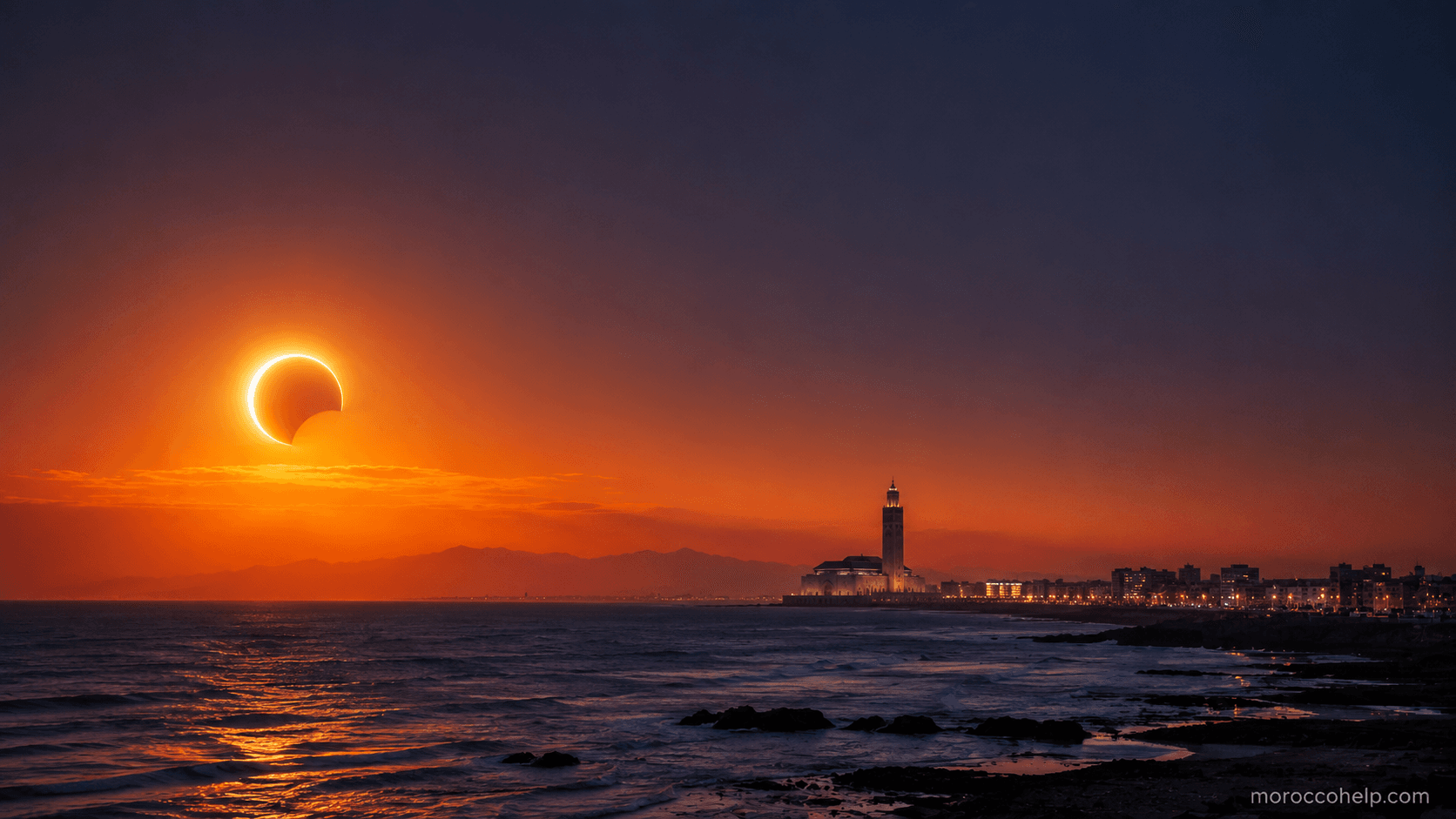
On the evening of Wednesday, August 12, 2026, Moroccans from Tangier to Dakhla looked westward toward the setting Sun and watched an extraordinary celestial alignment unfold. The Moon glided directly across the solar disk, carving a deep bite from the Sun and turning the familiar round orb into a brilliant crescent of light. Across the country the Sun was partially obscured by up to 93%, producing the most dramatic "sun with moon" event — the kossof (كسوف) — to grace Moroccan skies in years.
Although total darkness never reached Morocco (the path of totality passed far to the north, across Greenland, Iceland, and Spain), the event was visually stunning precisely because it happened low on the horizon at sunset, when atmospheric effects magnified the spectacle and the air took on an eerie, metallic twilight.
What Happened: The Eclipse at a Glance
- Date: Wednesday, 12 August 2026
- Global event: Total solar eclipse (magnitude 1.0386)
- Local type in Morocco: Deep partial solar eclipse — totality was not visible
- Window: roughly 18:44 to 20:40 (WEST), peaking near 19:40–19:46
- Maximum obscuration in Morocco: ~92.8% (Nador), with the northern half of the country all above 85%
- Lowest obscuration: ~55% in the far south (Lagouira)
- Defining feature: the eclipse occurred as the Sun was setting, so the maximum phase played out against a colourful western horizon
A "sun with moon" event — what Moroccans call kossof (كسوف الشمس) — happens when the Moon passes precisely between the Earth and the Sun, casting its shadow toward us. On August 12, the alignment was nearly perfect: the Moon's dark umbral cone touched the Earth across the North Atlantic, producing totality elsewhere, while Morocco sat inside the broader penumbral shadow and saw a deep partial eclipse instead.
The Science: Why the Sun and Moon Appear the Same Size
The most remarkable coincidence in astronomy is that the Sun is about 400 times larger than the Moon — but it also lies roughly 400 times farther away. From Earth, the two disks appear almost exactly the same angular size, about half a degree across. When the Moon's orbit carries it across the Sun-Earth line (a moment called a syzygy), it can cover the Sun entirely, producing a total eclipse.
Eclipses do not happen every new moon because the Moon's orbit is tilted by about 5° relative to Earth's path around the Sun. Most months, the Moon passes above or below the Sun from our viewpoint. Only when a new moon occurs near one of the two orbital nodes (the crossing points, called saros gateways) does an eclipse occur. On August 12, 2026, that geometry aligned perfectly — and Morocco enjoyed a prime seat for the partial phase.
City-by-City: Obscuration and Timing
Obscuration measures the fraction of the Sun's visible area hidden by the Moon at maximum eclipse. All times are local (WEST, Western European Summer Time, UTC+1).
| City | Max obscuration | Start | Maximum | End | Eclipse-day cloud cover |
|---|---|---|---|---|---|
| Nador | ~92.8% | ~18:45 | 19:40 | ~20:32 | moderate |
| Tangier | 92.0% | 18:44 | 19:40 | 20:31 | ~57% |
| Fès | 89.5% | 18:47 | 19:42 | 20:33 | ~11% |
| Rabat | 88.3% | 18:47 | 19:43 | 20:34 | ~45% |
| Casablanca | 86.9% | 18:48 | 19:43 | 20:35 | ~46% |
| El Jadida | 85.7% | 18:49 | 19:44 | 20:36 | ~55% |
| Marrakech | 82.9% | 18:52 | 19:46 | 20:38 | ~7% (very clear) |
| Agadir | 79.4% | 18:54 | 19:49 | 20:40 | ~14% |
| Lagouira | ~55.2% | — | ~19:50 | — | — |
The pattern is intuitive: the farther north, the deeper the eclipse. Tangier and Nador, facing the Strait of Gibraltar and the Mediterranean, saw the Moon swallow more than nine-tenths of the Sun. Southern cities like Agadir and Lagouira, lying farther from the central shadow, saw a noticeably smaller bite.
A Note on the Weather
Clear skies made viewing excellent across the interior. Fès (~11% cloud) and Marrakech (~7% cloud) enjoyed nearly pristine conditions, while the Atlantic coast was more mixed — Casablanca and Rabat contended with around 45–46% cloud, and Tangier with ~57%, though the eclipsed Sun broke through often enough for most observers.
The day after the event, conditions remained representative of an August spell: Casablanca sat at a mild 27 °C under clear skies with a gentle north-northwesterly breeze, while Marrakech baked at 40 °C under 68% cloud — a reminder of how dramatically the climate diverges between coast and interior at this time of year, and of the wider summer heat the country has been enduring.
Why a Sunset Eclipse Is So Special
A partial eclipse at midday is impressive, but a sunset eclipse is on another level. Three effects conspire to make the August 12 event visually unforgettable:
- Atmospheric magnification. When the Sun is on the horizon, refraction through Earth's atmosphere slightly flattens and distorts the solar disk, making the silhouette of the Moon appear to stretch and shimmer.
- Colour and contrast. The eclipsed crescent Sun sat against the oranges, pinks, and deep blues of twilight, so the "missing" chunk of the Sun read as a stark black bite against colour rather than against a blank daytime sky.
- Changing light. Because the eclipse deepened as the Sun dropped, the landscape experienced a double dimming — the natural fade of sunset amplified by the Moon's shadow — producing an unusual silvery, late-day light that photographers chased along the Atlantic coast.
For a sunset eclipse, a low horizon to the west is essential. Morocco's Atlantic beaches (near Casablanca, El Jadida, and Agadir) and the plains around Marrakech offer some of the longest, cleanest sightlines to the setting Sun anywhere in the country.
Eye Safety: How to Watch a Solar Eclipse Without Damage
This cannot be stressed enough: it is never safe to look directly at the Sun — even when it is 90% covered, even at sunset, even through clouds or a phone camera. The remaining crescent delivers enough focused radiation to cause permanent retinal damage in seconds, and because the retina has no pain receptors, you would not feel the injury happening. The same radiation makes everyday sun protection essential — see our Morocco UV index guide for year-round data.
Sunglasses, smoked glass, exposed film, CDs, binoculars, or telescope eyepieces do not protect you during a solar eclipse. Only ISO 12312-2 certified eclipse glasses — or indirect projection methods — are safe for direct viewing. Using binoculars or a telescope without a certified front solar filter will cause instant, severe eye injury.
Safe viewing methods:
- Eclipse glasses rated to the ISO 12312-2 international standard. Inspect them for scratches or pinholes before use, and put them on before looking up.
- Pinhole projection. Punch a small hole in a card, hold it up, and let the Sun's image fall on a second card or the ground a metre or so behind it. You will see a tiny but crisp crescent of light — a perfectly safe, projected view of the eclipse.
- Kitchen colander. The many holes of a colander each act as a pinhole, projecting dozens of little eclipses onto a sheet of white paper. A favourite trick with children.
- Welding glass, shade 14 or darker, is an acceptable substitute if eclipse glasses are unavailable.
Capturing the Eclipse: Quick Photography Tips
A phone camera will not capture the eclipse crescent on its own — it will overexpose and show only a white blob. Place an eclipse glass filter over the phone lens, tap to focus on the Sun, and lower the exposure slider until the crescent shape appears.
- Use the longest zoom your phone or camera allows.
- Rest the device on a wall or tripod; at maximum zoom, even tiny shakes blur the image.
- For landscape shots of the eclipsed sunset, expose for the sky, not the Sun — this preserves the colours and silhouette.
- Shoot continuously through maximum eclipse; the crescent thins and rotates as the Moon slides across.
The Eclipse Prayer: A Word on Salat al-Kusuf
In Islam, a solar eclipse — kossof (كسوف) — is a sign of Allah, and the Prophet Muhammad ﷺ established a special congregational prayer for it, Salat al-Kusuf. Yet Salat al-Kusuf was not held in Morocco for the August 12, 2026 eclipse. Because the eclipse fell in the late afternoon — after the Asr prayer and before Maghrib, one of the times when voluntary (nafl) prayers are religiously disliked — Morocco's Ministry of Awqaf and Islamic Affairs announced that, following the relied-upon position (mu'tamad) of the Maliki school, the eclipse prayer would not be performed. Moroccan Muslims were instead encouraged to make du'ā', dhikr, and istighfār individually until the eclipse cleared. For the full fiqh of eclipse-prayer timing and what to do when an eclipse falls in a disliked time, see our companion guide on Salat al-Kusuf and the 2026 ruling over on the MoroccoHelp Islam portal.
The next major eclipse, the total solar eclipse of 2 August 2027, is a morning event (peaking around 09:45 local time), which falls inside the Maliki valid window for the eclipse prayer. So while Salat al-Kusuf was not performed in 2026, it is expected to be held in mosques across the kingdom in 2027.
When Is the Next Eclipse Visible from Morocco?
The good news for sky-watchers: Morocco is entering an exceptionally rich eclipse season.
- 28 August 2026 — a partial lunar eclipse will be visible across the country, the Moon passing through part of Earth's shadow. No eye protection is needed for lunar eclipses.
- 6 February 2027 — a partial solar eclipse at sunrise, the Moon taking a smaller bite out of the Sun.
- 2 August 2027 — the headline event. A total solar eclipse whose path of totality crosses southern Morocco directly, along with parts of southern Spain and North Africa. This will be the first time in decades that Moroccans can experience true totality — the Sun's ghostly corona, plummeting temperatures, and stars in the middle of the day — without leaving the country.
The August 2, 2027 total eclipse is already being called "the eclipse of a generation" for the Maghreb. Southern Moroccan towns along the path are expected to draw large crowds of eclipse chasers, so planning accommodation and certified viewing equipment well ahead is strongly advised.
FAQ
Was the August 12, 2026 eclipse total in Morocco?
No. Morocco saw a deep partial solar eclipse, with the Moon covering up to about 93% of the Sun from the northern cities. The path of totality — where the Sun was completely hidden — passed across Greenland, Iceland, northern Russia, the North Atlantic, and northern Spain, but did not reach Moroccan territory.
What does "kossof" mean?
Kossof (كسوف) is the Arabic word for an eclipse, specifically a solar eclipse (kossof ash-shams, كسوف الشمس). The companion term for a lunar eclipse is khoussouf (خسوف). Because the August 12, 2026 eclipse occurred after Asr, the special eclipse prayer (Salat al-Kusuf) was not held in Morocco — see our Salat al-Kusuf 2026 ruling guide.
At what time did the eclipse peak in Casablanca?
In Casablanca, the partial eclipse began at 18:48, reached its maximum (about 87% obscuration) at 19:43, and ended at 20:35 WEST — right around sunset.
Is it dangerous to look at a solar eclipse?
Yes. Looking directly at the uneclipsed or partially eclipsed Sun can cause permanent eye damage or blindness, and the danger is not reduced at sunset or through cloud. Always use ISO 12312-2 eclipse glasses or an indirect projection method such as pinhole projection.
Why was this eclipse best seen from northern Morocco?
The depth of a partial eclipse depends on how close a location lies to the central line of the Moon's shadow. The August 12, 2026 shadow track ran from the North Atlantic toward Iceland and Spain, so northern Moroccan cities (Tangier, Nador, Fès) — geographically nearest that track — saw the deepest obscuration, while southern cities saw less.
When is the next total solar eclipse visible from Morocco?
On 2 August 2027, a total solar eclipse will cross southern Morocco directly, offering the country its first experience of totality in many years. A partial lunar eclipse on 28 August 2026 comes sooner.
Conclusion
The August 12, 2026 "sun with moon" event was a quiet triumph of celestial mechanics — a reminder that the Sun and Moon, the two brightest objects in our sky, still perform for us on a predictable, ancient schedule. Across Morocco, from the clear skies over Marrakech to the cloud-swept Atlantic coast, observers saw the Moon carve a deep crescent from the setting Sun, then drop below the horizon still partly eclipsed. It was not totality. But it was beautiful — and it sets the stage for something even greater on 2 August 2027, when the Moon will, at last, extinguish the Sun completely over southern Morocco.