Earthquakes Around Morocco & Egypt: August 2026 Seismic Surge
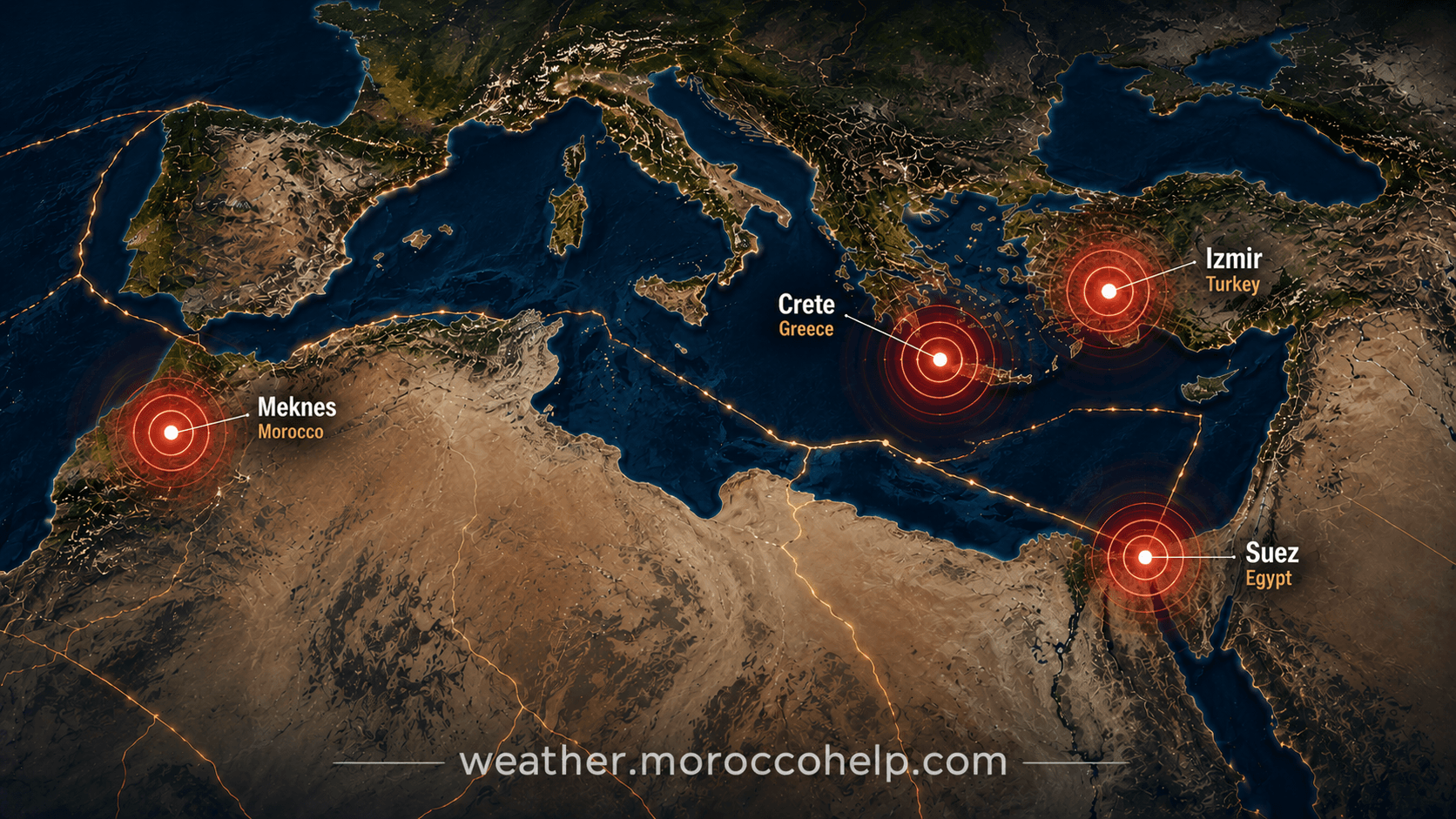
The Eastern Mediterranean-North Africa corridor has been jolted by a notable surge of seismic activity in late July and early August 2026. A magnitude 5.3 earthquake struck near Suez, Egypt today (August 3), following a magnitude 4.8 tremor near Meknes, Morocco on August 1, minor quakes compounding an already devastating flood crisis in northern Morocco, and a magnitude 6.1 earthquake off Crete on July 24 that was felt across Egypt, Israel, and Turkey.
While none of these events caused major damage, the clustering across multiple tectonic zones in such a short window is worth understanding. Here is a full breakdown of what happened, why, and what it means for the region.
Egypt: M5.3 Near Suez — August 3, 2026
The most significant event of this seismic cluster struck in the early hours of today.
| Detail | Value |
|---|---|
| Magnitude | 5.3 mb |
| Location | 41 km NNE of Suez, Egypt |
| Coordinates | 30.321°N, 32.679°E |
| Depth | 10.0 km (shallow) |
| Time (UTC) | 2026-08-03 00:00:33 |
| Time (Local) | 2:00 AM Cairo time |
| Source | USGS NEIC (Reviewed) |
At magnitude 5.3 and only 10 km deep, this earthquake had the potential to be widely felt across the Suez Canal zone, the Sinai Peninsula, and potentially parts of the Cairo delta region. Shallow earthquakes concentrate their energy closer to the surface, amplifying ground shaking. The USGS "Did You Feel It?" system collected community responses indicating light to moderate shaking near the epicenter.
Why the Gulf of Suez matters
The Gulf of Suez sits at the northern end of the Red Sea Rift, a spreading boundary between the African and Arabian plates that has been actively pulling apart for roughly 30 million years. Seismic slip rates in the Suez Rift are estimated at 0.15–0.35 cm per year — slow by human standards, but enough to generate moderate earthquakes. The region has produced significant events before, including a M6.8 earthquake near Shadwan Island in 1969 that caused damage across the Red Sea coast, and the M7.2 Nuweiba earthquake of 1995, the largest in Egypt's modern history.
Egypt's National Research Institute of Astronomy and Geophysics (NRIAG) operates the national seismic network and issues real-time earthquake bulletins. Their catalog is the primary local source for tremors felt within Egypt.
Morocco: M4.8 Near Meknes — August 1, 2026
Two days before the Suez event, Morocco was shaken by its own notable tremor.
| Detail | Value |
|---|---|
| Magnitude | 4.8 (also reported as 4.3 by some agencies) |
| Location | 13.5 km from Ouislane, Fez-Meknes region |
| Depth | 15 km (shallow) |
| Time (Local) | Saturday, August 1, 2026 at 7:34 AM |
| Source | EMSC, local reports |
The quake was felt across the Fez-Meknes region, including the cities of Fez and Meknes, but no casualties or material damage were reported. At magnitude 4.8, the tremor was strong enough to rattle windows and wake residents but remained well below the threshold for destructive damage.
On the same day, northern Morocco — already reeling from weeks of devastating flooding — was struck by two minor earthquakes (one measuring 3.8), compounding an ongoing humanitarian crisis.
Context: Morocco's flood-earthquake double hit
Northern Morocco has been in crisis since Storm Leonardo displaced over 140,000 people in February 2026, with the Loukkos River flooding Ksar el-Kebir and surrounding provinces. The region remains vulnerable, and adding seismic tremors — even minor ones — to saturated ground and compromised infrastructure raises compound risk. Earthquakes during or after heavy rainfall can trigger landslides in hilly terrain, and flood-weakened structures are more susceptible to quake damage.
Even moderate earthquakes (M3.0–5.0) can cause significant problems in areas where infrastructure has already been weakened by flooding or poor construction. If you feel shaking in a flood-affected area, move away from compromised buildings and slopes immediately.
For the broader picture of Morocco's seismic zones and history, see our comprehensive earthquake risk guide, and for the flooding situation, our flash floods dossier.
The Eastern Mediterranean Chain: Crete and Turkey
The seismic activity was not limited to North Africa. The Hellenic Arc — one of the most seismically active zones on Earth, where the African plate subducts beneath the Eurasian plate — has been producing its own significant events.
| Date | Location | Magnitude | Depth | Felt In |
|---|---|---|---|---|
| Jul 24, 2026 | Off Crete, Greece | 6.1 | ~78 km | Greece, Turkey, Egypt, Israel |
| Jul 20, 2026 | Near Chania, Crete | 5.2 | ~9 km | Widespread Eastern Med |
| Jun 3, 2026 | Near Izmir, Turkey | 6.2 | — | Turkey, Greek islands |
| Aug 2025 | Bigadiç, Turkey | 6.1 | — | W. Turkey, Aegean islands |
The July 24 Crete earthquake, at magnitude 6.1 and a depth of 78 km, was widely felt. Residents in Cairo reported trembling, and shaking was noted as far away as Israel. Deep earthquakes like this one tend to be felt over very large areas but generally cause less localized damage than shallow events of the same magnitude.
Why Is the Region So Active Right Now?
The entire belt from the Azores through Morocco, Algeria, Tunisia, Libya, Egypt, the Red Sea, and into Turkey sits along the convergent boundary of the African and Eurasian tectonic plates. This is not a single fault but a complex system of:
- Subduction zones — The African plate dives under the Eurasian plate along the Hellenic Arc (Crete) and the Calabrian Arc (southern Italy), producing the largest earthquakes in the region.
- Continental collision — The same convergence pushes up the Atlas Mountains in Morocco and the Rif in the north, generating moderate intraplate earthquakes like the Meknes event.
- Rifting — The Red Sea Rift, including the Gulf of Suez and Gulf of Aqaba, is actively spreading as the Arabian plate pulls away from Africa, producing moderate quakes like today's Suez event.
This cluster of events does not necessarily indicate a larger earthquake is coming. Seismic activity in this region fluctuates naturally. However, the July–August 2026 period has been notably active across multiple sub-zones simultaneously.
A Summary of Recent Notable Events
| Date | Event | Mag | Depth | Region | Key Detail |
|---|---|---|---|---|---|
| Aug 3 | Suez, Egypt | 5.3 | 10 km | Red Sea Rift | Shallow, widely felt in Suez zone |
| Aug 1 | Ouislane, Morocco | 4.8 | 15 km | Atlas | Felt in Fez-Meknes, no damage |
| Aug 1 | Northern Morocco | 3.8 | — | Rif | Flood-hit area, compounding crisis |
| Jul 24 | Off Crete | 6.1 | 78 km | Hellenic Arc | Felt in Egypt, Israel, Turkey |
| Jul 20 | Near Chania, Crete | 5.2 | 9 km | Hellenic Arc | Shallow, widely felt |
| Jul 2 | Off Derna, Libya | 4.0 | — | Eastern Med | Recorded by monitoring stations |
| Jun 3 | Near Izmir, Turkey | 6.2 | — | Aegean | Strong, felt across Greek islands |
| Mar 28 | Sidi Kacem, Morocco | 4.0 | 33 km | Atlas | No casualties |
| Feb 2025 | Ksar el-Kebir, Morocco | 5.1 | — | Rif | Recorded by USGS |
| Apr 2026 | NW Marsa Matrouh, Egypt | 5.12 | — | Med coast | Not felt in Egypt |
Preparedness: What to Do
Whether you are in Morocco, Egypt, or anywhere in the seismically active Mediterranean belt, the fundamentals of earthquake safety remain the same:
During an earthquake
- Drop, Cover, Hold On — drop to the ground, get under a sturdy table or desk, and hold on until shaking stops
- Stay away from windows, exterior walls, and anything that could fall
- If outdoors, move to an open area away from buildings and power lines
- If driving, pull over and stay inside your vehicle
After an earthquake
- Check for injuries and provide first aid
- Inspect utilities — shut off gas if you smell a leak
- Expect aftershocks, which can cause additional damage to weakened structures
- Listen to official information from authorities before returning to damaged buildings
For real-time seismic data, MoroccoHelp Meteo displays live earthquake information from the EMSC on the earthquake monitoring page. In Egypt, follow the NRIAG (National Research Institute of Astronomy and Geophysics) for local bulletins.
Emergency kit essentials
Keep a 72-hour emergency kit ready:
- Water: 3 litres per person per day
- Non-perishable food and a manual can opener
- Flashlight and spare batteries
- First aid kit
- Copies of important documents in a waterproof bag
- Whistle (to signal for help)
Key Takeaways
- A M5.3 earthquake near Suez, Egypt today (Aug 3) highlights the active seismic nature of the Red Sea Rift
- Morocco experienced a M4.8 tremor near Meknes on Aug 1 plus minor quakes in its flood-ravaged north
- A M6.1 off Crete on Jul 24 was felt across Egypt, Israel, and Turkey
- These events span three distinct tectonic systems: the Red Sea Rift, the Atlas collision zone, and the Hellenic Arc subduction zone
- The clustering does not necessarily signal a larger event, but underscores the importance of preparedness across the region
Sources
- USGS Earthquake Hazards Program — Event page us6000thpb (M5.3 near Suez, Aug 3, 2026)
- EMSC (European-Mediterranean Seismological Centre) — Real-time earthquake catalog
- NRIAG (National Research Institute of Astronomy and Geophysics, Egypt) — National seismic network bulletin
- Hespress EN — "Residents feel 4.8-magnitude tremor near Meknes" (Aug 1, 2026)
- Anadolu Agency (AA) — "Flood-hit northern Morocco rocked by minor earthquakes"
- Reuters / Euronews / Al-Monitor — Morocco flood displacement reports (Feb 2026)
- Lloyd's Seismic Shock Report — Middle East hazard overview
- IRIS (Incorporated Research Institutions for Seismology) — Africa tectonic setting