Imzouren Flash Floods (October 6, 2026): What Happened in Morocco's Rif
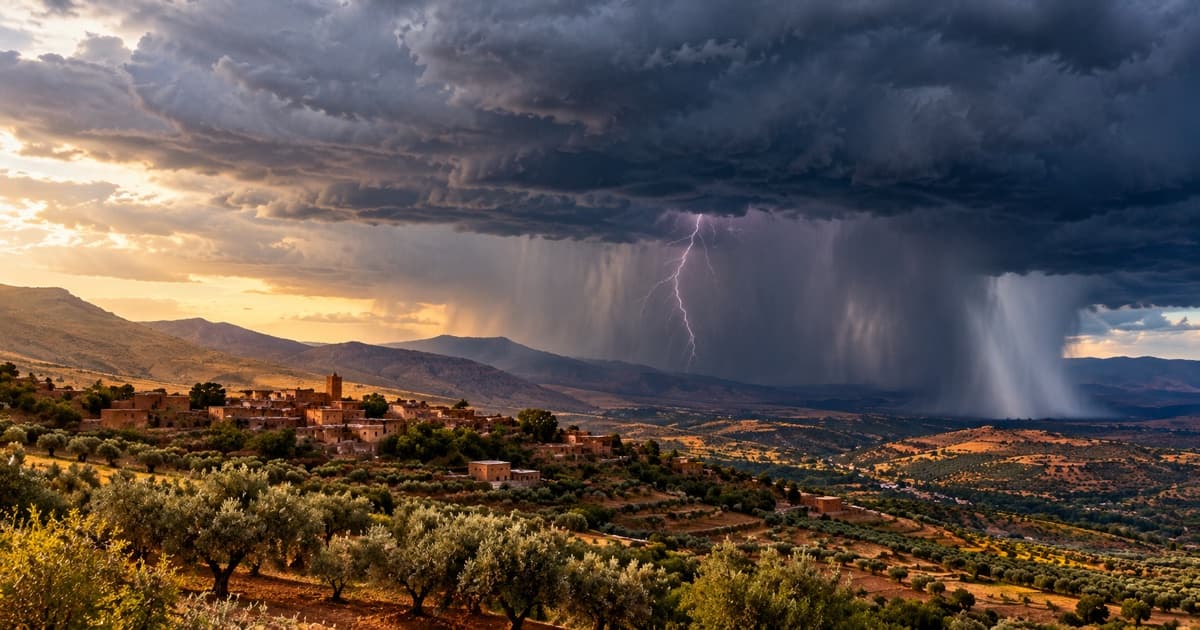
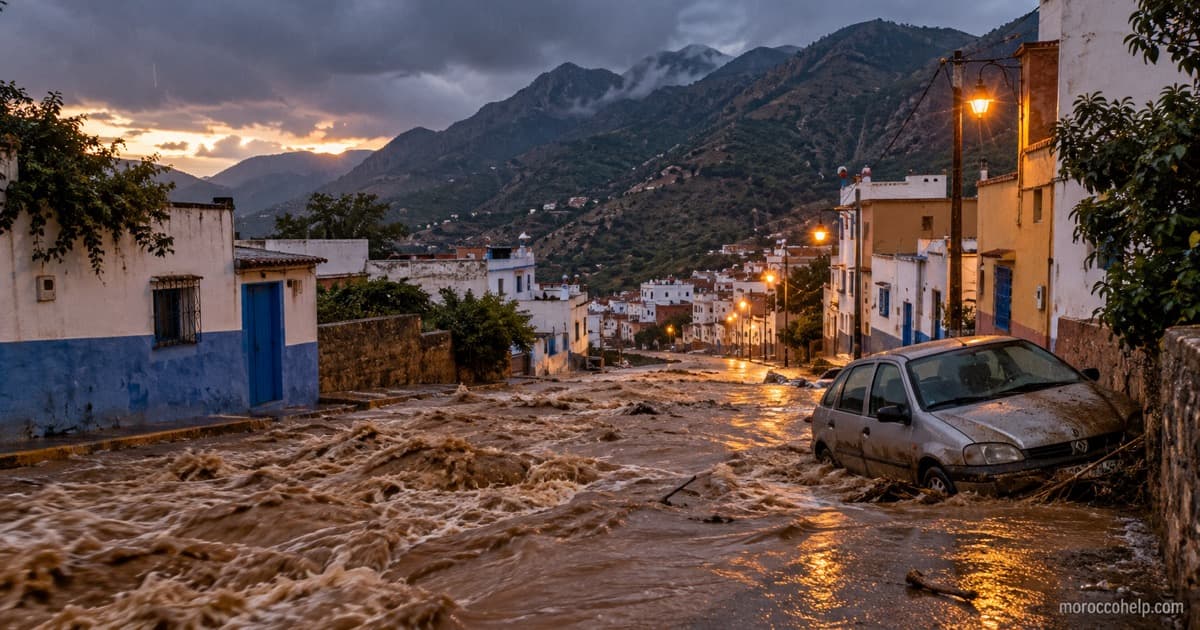
On the evening of Tuesday October 6, 2026, the town of Imzouren, one of the main localities of Al Hoceima province in the heart of the Rif mountains, was hit by a flash flood. Within minutes, intense thunderstorm downpours turned entire streets into torrents of muddy water, submerging roads and low-lying neighbourhoods before civil protection teams moved in. The episode opened a notably stormy week across Morocco, punctuated by a run of orange alerts — retraced in our October 2026 storm alerts overview.
What happened on October 6
The sequence is typical of an urban flash flood:
- Extremely intense downpours. In the evening, storm cells broke over the Imzouren area, dumping in a very short time volumes of water that urban drainage networks simply cannot absorb.
- Immediate runoff. On barely permeable soils and steep slopes, the water does not soak in: it converges instantly toward low points and roads, which act as flood channels.
- Streets as torrents. Footage broadcast by Moroccan media, notably 2M, shows streets transformed into fast, muddy rivers, displaced vehicles and residents taking refuge upstairs, while civil protection teams worked to rescue people and clear the situation.
To date, no official casualty or damage figures have been published for this episode. The spectacular images should not obscure the golden rule of flash flooding: the danger lies in how fast the water rises, not only in how much of it there is.
Imzouren and the Rif: a geography that amplifies everything
Imzouren (in Tarifit, "the springs") lies about fifteen kilometres south-west of central Al Hoceima, in the Nekor plain at the foot of the first Rif ridges. Several factors make the area exceptionally responsive to intense rain:
- Abrupt, nearby relief. Rif slopes drop quickly toward the plain: water arrives very fast, concentrated by short, narrow valleys (wadis).
- Barely permeable terrain. The Rif's marls, clays and weathered rocks favour runoff over infiltration.
- Patchy vegetation cover. On degraded slopes, vegetation no longer brakes the water, which runs off even faster.
- Urban growth in low-lying spots. Like many Rif towns, Imzouren expanded around its historic axes, sometimes close to thalwegs and wadi floodplains.
Combine the four and a one-hour downpour can produce in town what the same volume would need twelve hours to achieve in a sandy plain.
Why flash floods are so dangerous
Our complete guide to flash floods in Morocco details the mechanism; in short:
- A few dozen centimetres are enough. 30 cm of moving water can knock an adult down; 60 cm can sweep a car away.
- Rising takes minutes. Between the first storm and the flood there is often less than an hour — too little to organise an evacuation.
- Bridges and fords are traps. Most fatal flood accidents happen on roads crossing a wadi.
Imzouren, first act of a stormy week
The Imzouren episode did not stay isolated. It opened a long-lasting unstable spell over the kingdom:
- From October 7, the DGM placed several provinces under orange vigilance for storms, hail and gusts, then 23 provinces on October 8 and 26 provinces on October 11.
- Between October 6 and 10, the Ministry of Equipment and Water counted 19 road sections cut by floods, five of them still closed on the evening of October 10, two on the Marrakech-Imlil axis.
- Further orange vigils followed, through the weekend of October 18-19.
In other words: what struck Imzouren on October 6 belongs to a sustained autumn storm regime that repeats with every disturbance — in the Rif as in the Atlas.
The right reflexes during a flash flood
- Never walk down into a wadi, even a dry one, while a storm rages upstream: the flood can arrive under a clear sky.
- Do not cross a flooded road: depth and current strength are impossible to judge from inside a car.
- Go upstairs immediately in flood-prone areas — never into basements or underground car parks.
- Move your car away from low points and riverbanks as soon as storms are announced.
- Follow civil protection instructions and the DGM vigils (green, yellow, orange, red) issued several times a day.
FAQ
Where is Imzouren?
In northern Morocco, Al Hoceima province, Tanger-Tetouan-Al Hoceima region, about 15 km south-west of Al Hoceima city, in the heart of the Rif.
When did the floods happen?
On the evening of Tuesday October 6, 2026, after extremely intense thunderstorm downpours; civil protection intervened immediately afterwards.
Were there any victims?
No official casualty or damage figures have been published for this episode as of the date of this article.
Why is the Rif so prone to flash floods?
Abrupt relief, barely permeable terrain, patchy vegetation and urbanisation near thalwegs: water converges extremely fast toward towns built in low-lying spots.
Are these storms linked to the October orange alerts?
Yes: Imzouren was the first major episode of a long stormy sequence that then hit 23 and later 26 provinces on October 8 and 11, and the country again on the weekend of October 18-19.