Morocco Dams August 2026: Filling Rates, Summer Drawdown and the Water Situation
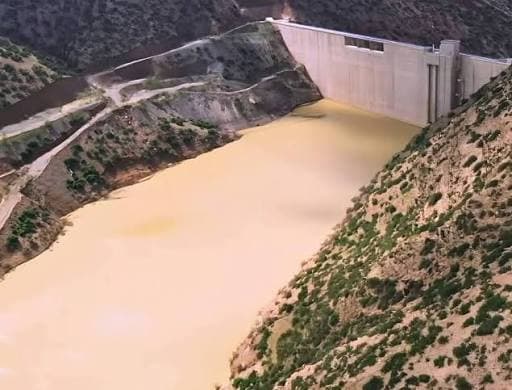
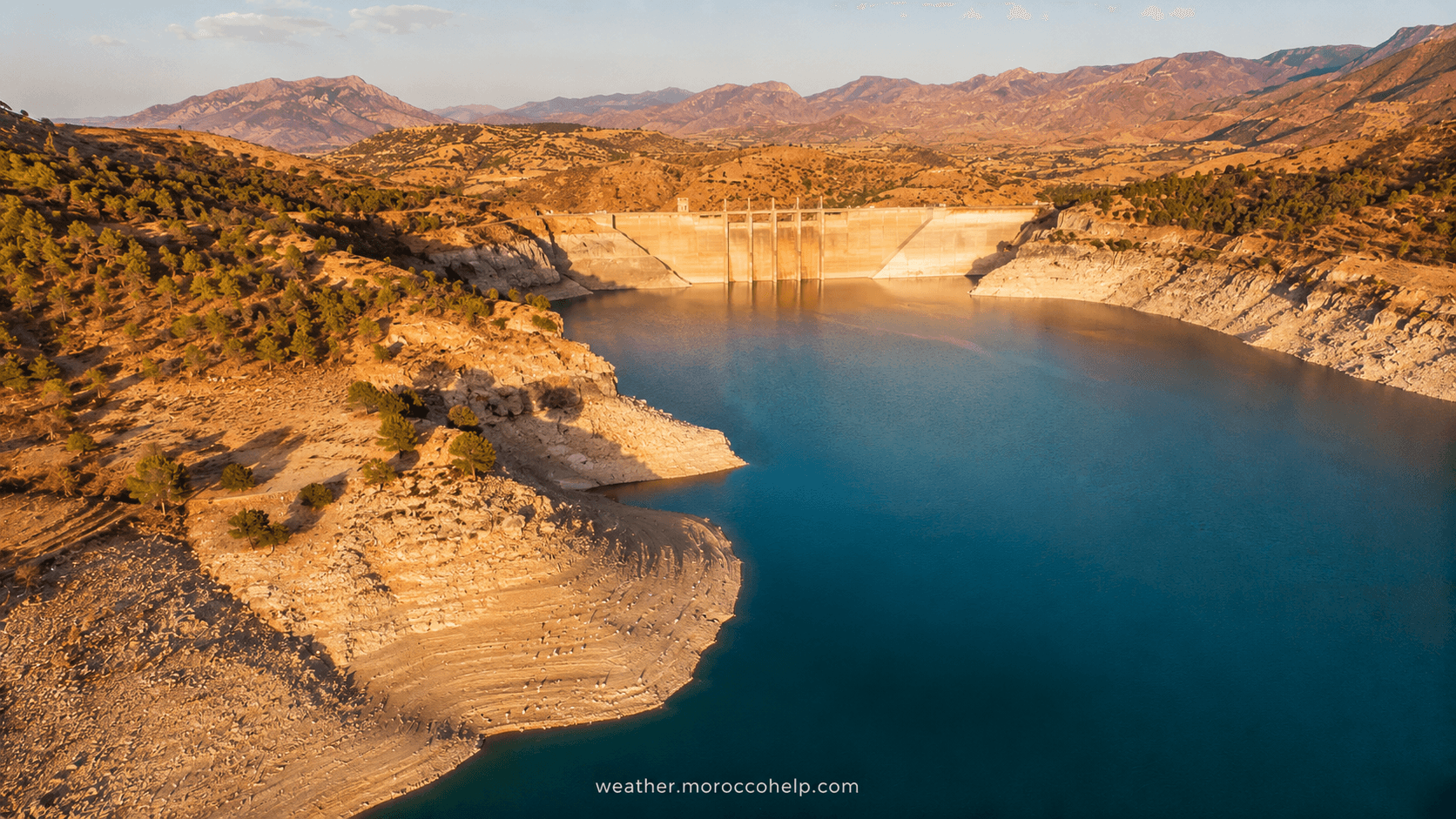
After years of punishing drought, 2026 has been the year Morocco's reservoirs finally breathed again. Heavy winter and spring rains pushed national dam reserves to their highest levels in half a decade. But summer is now taking its toll: the same heatwave that triggered the DGM's orange vigilance in early August is also drawing down the reservoirs. Here is where Morocco's dams stand in early August 2026, why levels fall at this time of year, and what it means for the months ahead.
For the story of a single strategic reservoir, see our Tiddas Dam guide, and for the wider hydrological context our Sebou basin situation analysis.
The national picture: recovery, then summer decline
The 2025-2026 hydrological year has been exceptional. After reaching a multi-year low near 8 billion m³ (about 48% fill) in January 2026, reserves climbed steeply through the winter and spring rains, peaking at roughly 76% (about 12.9 billion m³) by mid-May. Through June and July, the fill rate drifted gently downward as evaporation and irrigation demand began to bite.
By mid-July 2026, the national filling rate stood at about 72%, corresponding to around 12.2 billion m³ of stored water. As of early August 2026, the trend is clearly downward - the figure has slipped to roughly 70% - and the current heatwave, with temperatures of 44-47 C across the south and interior, is accelerating that decline through a combination of intense evaporation, soaring drinking-water and cooling demand, and continued irrigation withdrawals.
The headline message is reassuring compared with a year ago, but it should not breed complacency: Morocco is in a far stronger position than in summer 2025, but the summer drawdown is real and the next rainy season is still months away.
Filling rates by basin: a stark north-south contrast
Morocco's water wealth is unevenly distributed, and the August situation mirrors that geography. The humid north is near capacity, while the stressed southern and interior basins remain far below their potential.
| Basin / reservoir | Approx. fill (summer 2026) | Commentary |
|---|---|---|
| Loukkos (northern Atlantic) | ~94% (near full) | Saturated after the wet winter; the Oued El Makhazine reservoir even exceeded its normal operating capacity earlier in the year, forcing managed releases. |
| Sebou / Al Wahda (largest in Morocco) | Comfortably above average | Al Wahda, the kingdom's biggest dam (~3.8 billion m³ capacity), drives the national average and is well filled this year. |
| Bouregreg (Sidi Mohammed Ben Abdellah, Tiddas) | Moderate | The Tiddas Dam on the Bouregreg stood around 60% (about 304 Mm³ of its 507 Mm³ capacity); see our live Tiddas dashboard. |
| Oum Er-Rbia / Tensift (central Atlantic) | Variable, below northern basins | Irrigation demand is heavy here; levels are adequate but under pressure. |
| Souss-Massa and southern/Saharan basins | Low | The driest part of the country; despite some recharge, these basins remain structurally stressed. |
The contrast between the near-full Loukkos in the north and the still-thirsty Souss-Massa in the south is the single most important geographic fact in Moroccan water management, and it is why inter-basin transfers and desalination are now central to national strategy.
Why dam levels fall in summer
Three forces combine every summer to lower the reservoirs, and the August 2026 heatwave amplifies all three:
- Evaporation. A large open reservoir under a 45 C sun and dry Chergui wind loses substantial volumes of water directly to the atmosphere. The hotter and windier the weather, the larger the loss.
- Surging demand. Drinking-water consumption peaks (more showers, more cooling), industrial and tourism demand rises on the coast, and - critically - agriculture needs water precisely when no rain falls. Irrigation is by far the largest summer draw on Moroccan reservoirs.
- No recharge. From roughly May to October, rainfall across most of Morocco is negligible. Whatever leaves the reservoirs is not replaced, so the trend is one-directional until the autumn rains.
The result is a predictable seasonal curve: a steep rise through winter and spring, a gentle decline beginning in late spring, and an acceleration through July and August. 2026 is following that curve exactly - what is new is that the curve started from a much higher point than in the drought years.
How 2026 compares with the drought years
The contrast with the recent past is dramatic:
- Summer 2025 - the tail end of a multi-year drought. National fill was deep in the 20s%, many reservoirs at record lows, and several cities faced severe supply restrictions. Agriculture in the Souss and Haouz was under acute stress.
- Summer 2026 - fill around 70% (roughly 3x the level of the same period a year earlier for the national aggregate). The recovery is genuine and was driven by an exceptionally wet cold season - including the storms and floods that hit the north in early 2026.
This does not mean the structural water deficit is solved. Morocco remains a water-stressed country by international standards, with per-capita renewable resources well below the scarcity threshold, and climate projections point to further declines in average rainfall and higher evaporation. One wet year is a reprieve, not a reversal.
What the August situation means in practice
- Drinking water - Supplies are secure nationwide for the remainder of summer 2026, including for the large corridor served by the Bouregreg system (Tiddas and Sidi Mohammed Ben Abdellah dams supply the Kenitra-Rabat-Casablanca axis and more than 8 million people). No major rationing is anticipated on the scale seen in 2025.
- Irrigation - Allocations are more generous than last year, but the Ministry of Agriculture and the river basin agencies continue to manage demand, particularly in the southern basins where stress persists.
- Energy - Hydropower output benefits from fuller reservoirs, though it remains a modest share of the national mix compared with solar and wind (see our Morocco renewable energy 2030 guide).
- Flood risk transition - The same dams that are now carefully releasing water were, in early 2026, managed to prevent downstream flooding when northern reservoirs overfilled. Dam operators must balance keeping reserves for the dry season against leaving room for possible autumn storm inflows.
Looking ahead: the autumn inflection point
The summer drawdown will continue through September and into October, with the national fill rate likely to bottom out before the first significant autumn rains. The direction of the next hydrological year depends almost entirely on the volume and timing of that rainfall. Given the climate-change pressures already visible in Morocco - shorter, more intense rainy seasons and longer dry spells - the strategy is no longer to rely on a single wet year but to diversify: more dams, inter-basin transfers, widespread desalination on the coast, and wastewater reuse.
For now, early August 2026 offers a rare piece of good news: Morocco's reservoirs are entering the hardest part of the year from a position of strength. The challenge is to keep it that way.
Sources
- Direction de la Météorologie Nationale / basin agencies (ABH) reservoir situation bulletins, summer 2026.
- Agence du Bassin Hydraulique du Bouregreg et de la Chaouia (ABHBC), "Situation des barrages" (status as of 4 August 2026).
- Medias24, "Barrages: les reserves atteignent 8 milliards de m3" (January 2026 baseline).
- Le Matin, national dam filling-rate tracking (spring-summer 2026).
- Maroc Diplomatique, "Barrages au Maroc: apres les pluies de 2026, un nouvel enjeu menace les reserves en eau" (July 2026).
Track an individual reservoir on our live dam-levels dashboards, and read the wider context in our Sebou basin hydrological situation and Tiddas Dam guide.