Morocco's Renewable Energy Target by 2030: Progress, Projects, and Challenges
Morocco has positioned itself as Africa's leader in renewable energy. Through an ambitious national strategy backed by legislative frameworks and massive infrastructure investment, the Kingdom aims to source 52% of its installed electricity capacity from renewable sources by 2030 — and 80% by 2050. This article examines the current state of progress, the key projects driving the transition, and the challenges ahead.
The 52% Target in Context
Morocco's renewable energy target was formalised in its Nationally Determined Contribution (NDC), submitted to the UNFCCC in 2021. The target breaks down as follows:
- 20% solar — concentrated solar power (CSP) and photovoltaic (PV)
- 20% wind — onshore wind farms, with offshore potential being assessed
- 12% hydroelectric — conventional dams and pumped-storage stations
As of the end of 2024, Morocco's total installed electricity capacity reached 12,016 MW, with renewables accounting for 45.3% of that total (Energy Partnership Morocco-Germany, 2025). While still below the 52% target, this represents remarkable progress from just 17% a decade earlier.
Legislative Framework
Morocco's renewable energy transformation is underpinned by a series of landmark laws:
- Law 13-09 (2010) — Opened the renewable energy sector to private competition, allowing independent producers to generate and sell electricity from solar, wind, and hydro sources.
- Law 58-15 (2016) — Expanded direct sales opportunities and raised the minimum threshold for hydro projects from 12 MW to 30 MW.
- Law 82-21 (2023) — Established a comprehensive framework for electricity self-generation, enabling households, industries, and local authorities to produce and sell surplus energy.
- Law 40-19 (2023) — Introduced the concept of network hosting capacity and clarified grid access rules.
The National Electricity Regulatory Authority (ANRE), created by Law 48-15, oversees market transparency and sets network access tariffs.
Solar Energy: The Noor Complex and Beyond
Solar power is the cornerstone of Morocco's strategy, leveraging the country's exceptional solar irradiance — among the highest in the world at 5.3 kWh/m²/day.
The Noor Ouarzazate Complex
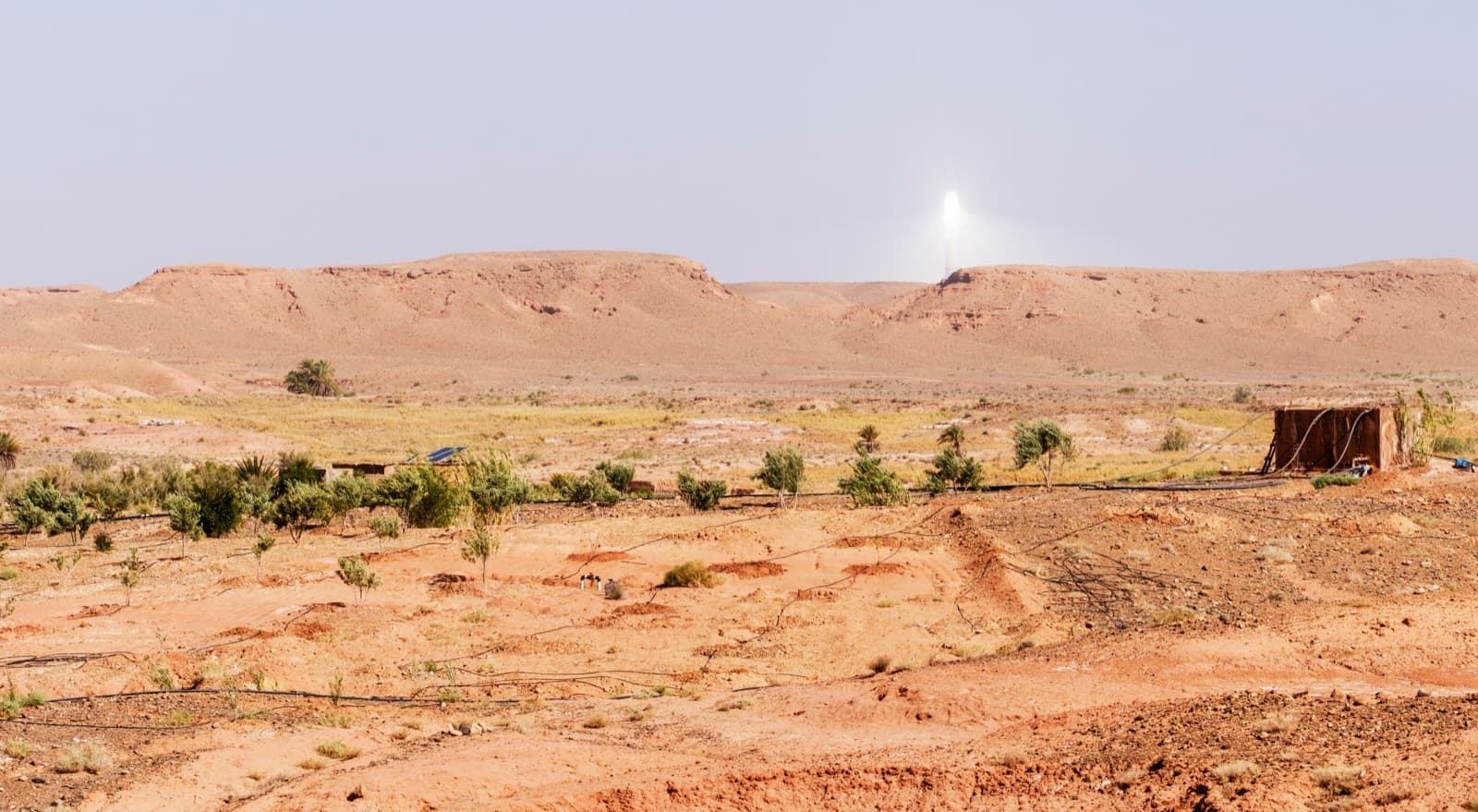
The flagship of Morocco's solar programme is the Noor Ouarzazate Solar Power Station in the Draa-Tafilalet region, one of the world's largest concentrated solar power complexes:
| Phase | Technology | Capacity | Status |
|---|---|---|---|
| Noor I | CSP Parabolic Trough | 160 MW | Operational since 2016 |
| Noor II | CSP Parabolic Trough | 200 MW | Operational since 2018 |
| Noor III | CSP Solar Tower | 150 MW | Operational since 2018 |
| Noor IV | PV Photovoltaic | 72 MW | Operational since 2018 |
Total capacity: 582 MW across approximately 3,000 hectares, capable of powering hundreds of thousands of homes. The complex uses molten salt thermal storage to generate electricity even after sunset.
Noor Midelt
The Noor Midelt I project (800 MW) represents Morocco's next generation of solar plants, combining hybrid CSP-PV technology. Located between the Middle and High Atlas mountains, it was initially planned for completion in 2022 but faced delays. Construction is ongoing with operations expected to commence soon.
The Noor Midelt II (400 MW) is in the planning stage, which would bring the total Midelt complex to 1,200 MW.
Noor Laayoune and Boujdour
Smaller PV plants in Morocco's southern provinces:
- Noor Laayoune — 80 MW, operational since 2018
- Noor Boujdour — 20 MW, operational since 2018
2024-2026 Pipeline
According to MASEN's approved programme, approximately 1.7 GW of new renewable capacity is planned to come online between 2026 and 2030, with multiple solar projects at various stages of development.
Wind Energy: Africa's Leading Market
Morocco's wind energy programme has been the most successful component of its renewable strategy, consistently exceeding targets.
Current Status (2024)
- Installed wind capacity: 2,433 MW across 23 authorised projects (MASEN/Ecofin Agency, 2025)
- Morocco was the only African country to expand wind capacity in 2019 and 2020
Key Wind Farms
- Tarfaya (301 MW) — Africa's largest wind farm at commissioning in 2014, with 131 Siemens turbines
- Akhfennir I & II (200 MW combined) — Near Tarfaya, operated by Nareva
- Jbel Khalladi (120 MW) — Near Tangier, 44 turbines of 2.7 MW each
- Tanger I (140 MW) — Northern Morocco, operated by ONEE
- Koudia Al Baida (50 MW) — Morocco's first wind farm, operational since 2000; repowering project underway
National Wind Plan
The government's 2030 National Wind Plan targets a total wind capacity of 2.2 GW. Ten additional wind projects with a combined capacity of over 900 MW are planned for the 2022-2025 period.
Offshore Potential
A 2019 World Bank study estimated Morocco's offshore wind energy potential at 200 GW (22 GW fixed-bottom, 178 GW floating). While no commercial offshore projects are yet underway, this represents a significant long-term opportunity.
Hydropower: Storage and Grid Stability
Hydropower provides crucial baseload capacity and grid stability for Morocco's renewable-heavy energy mix.
Current Status
- Installed hydro capacity: 1.8 GW (IRENA, 2022)
- Mix of conventional hydroelectric dams and pumped-storage facilities
Major Installations
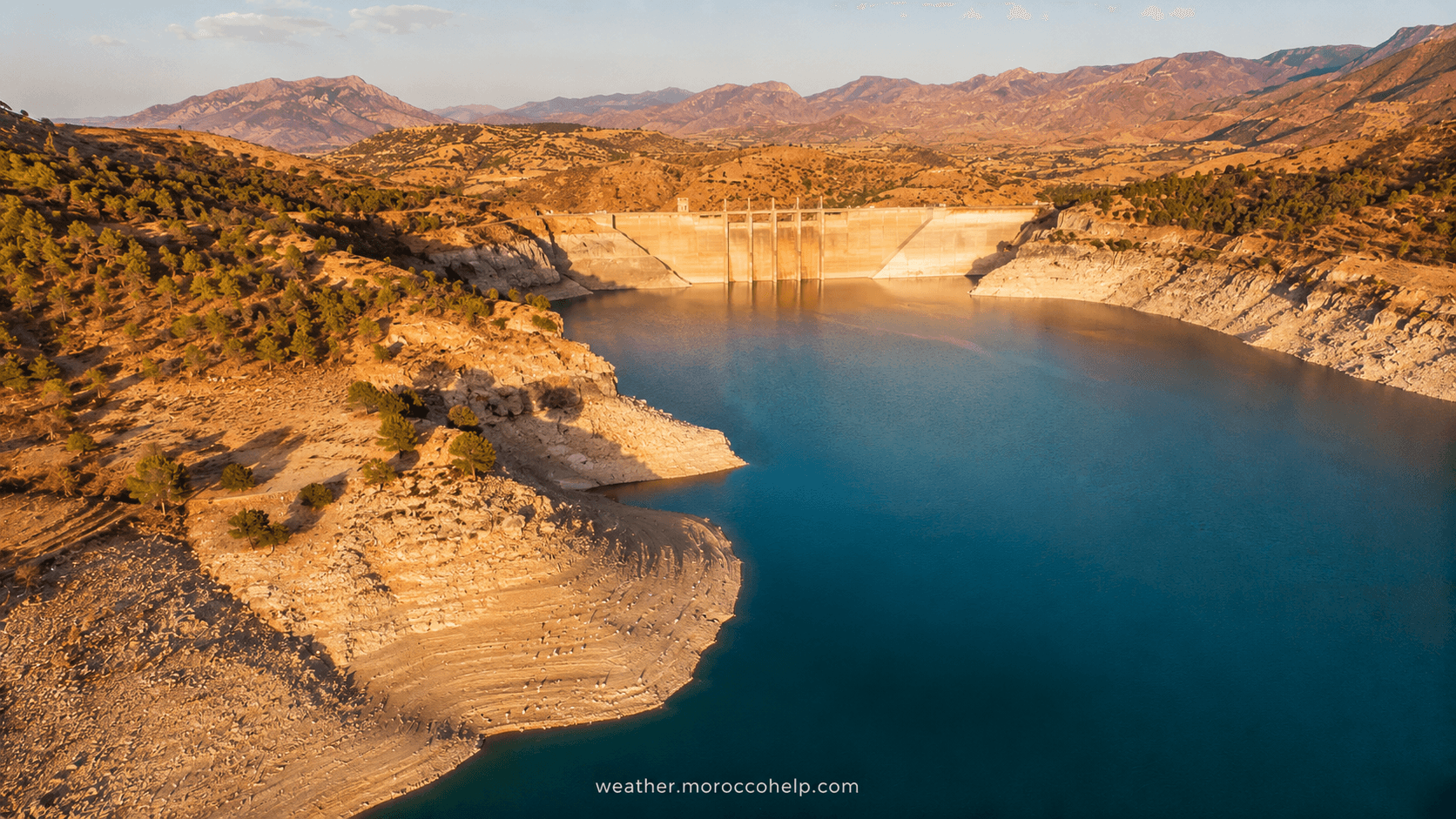
- Al Wahda Dam (400 MW) — Morocco's largest dam, on the Ouerrha river
- Bin El Ouidane (135 MW) — Arch dam on the El Abid river, operational since 1953
- Afourer (465 MW) — One of Africa's oldest pumped-storage stations, operational since 1954
New Capacity Under Construction
Three pumped-storage hydropower plants (STEP) are under construction:
- STEP Abdelmoumen (350 MW) — Near Agadir, under construction by ONEE and VINCI
- Two additional 300 MW STEP plants — Expected to start operating between 2027 and 2029
These plants are critical for managing the intermittency of solar and wind generation, storing excess energy during peak production and releasing it during demand peaks.
The Coal Challenge
Despite renewable progress, coal still accounted for approximately 60% of Morocco's electricity production in 2024. The country has historically relied heavily on coal imports, with total coal generating capacity amounting to around 4 GW.
Morocco endorsed the coal exit pledge at COP26, agreeing to cease construction of new coal plants. However, it has not committed to a full phase-out by 2040. The Jorf Lasfar Coal Park (2.05 GW) was commissioned in 2022, extending coal dependency.
The transition from coal to renewables remains the central challenge of Morocco's energy strategy.
MASEN: The Driving Force
The Moroccan Agency for Sustainable Energy (MASEN) is the primary institution responsible for scaling renewable energy capacity. Created to lead the country's solar and wind programmes, MASEN oversees project development, secures financing, and manages public-private partnerships.
As of 2024, MASEN has approved a 1.7 GW renewable energy programme covering the 2026-2030 period, signalling continued acceleration of the renewable buildout.
Green Hydrogen Ambitions
Morocco's abundant solar and wind resources make it a strong candidate for green hydrogen production. The National Hydrogen Commission's roadmap, published in 2021, projects hydrogen demand of 14-30 TWh by 2030 and 156-307 TWh by 2050.
References
- Climate Action Tracker — Morocco Policies & Action — Comprehensive analysis of Morocco's climate policies and NDC targets
- Energy Partnership Morocco-Germany — Electricity Market — Detailed overview of Morocco's electricity market, installed capacity data, and regulatory framework
- International Renewable Energy Agency (IRENA) — Renewable Energy Statistics — Official renewable energy capacity data for Morocco
- Kingdom of Morocco — NDC 2021 — Morocco's updated Nationally Determined Contribution submitted to the UNFCCC
- Kingdom of Morocco — Long-Term Strategy 2050 — Long-term low-emission development strategy
- ONEE — Office National de l'Electricite et de l'Eau Potable — National electricity and water utility
- MASEN — Moroccan Agency for Sustainable Energy — Primary agency for renewable energy development