Morocco Fog & Mist Guide: Where, When & Why It Happens
Fog is one of Morocco's most distinctive and under-discussed weather features. Casablanca, the country's economic capital, averages 60–80 fog days per year — comparable to San Francisco. The Strait of Gibraltar area experiences some of the densest coastal fog on the planet, a fact that surprises many visitors expecting clear North African skies.
Understanding when and where fog forms matters for travel planning, road safety and photography. Here is a breakdown of Morocco's fog patterns.
Fog is defined as visibility below 1,000 meters (0.6 miles). Mist is visibility between 1,000 and 5,000 meters. Both are common in Morocco but fog has a much bigger impact on transport and daily life.
Two Types of Fog in Morocco
1. Advection Fog (Coastal Fog)
This is the dominant fog type along Morocco's Atlantic coast. It forms when warm, moist air moves over the cold Canary Current water that runs close to shore. The air cools to its dew point, and water vapor condenses into a low cloud that sits at ground level.
Where: The entire Atlantic coast from Tangier to Agadir, but most persistent between Larache and El Jadida (the central coastal plain).
When: Year-round, but most frequent from June to September. This is the "Moroccan fog season" — counterintuitively, the hottest months also produce the most fog on the coast. The reason: the temperature difference between the cold ocean (~18°C) and hot inland air (~30°C+) is at its maximum, driving strong advection.
Pattern: Fog typically forms overnight and in the early morning, then burns off by mid-morning as the sun heats the land. However, during strong onshore winds, coastal fog can persist through the entire day and push several kilometers inland.
Dense coastal fog between Casablanca and El Jadida regularly reduces highway visibility to below 100 meters. The A1 and A7 autoroutes in this corridor experience fog-related accidents every summer.
2. Radiation Fog (Inland Fog)
This type forms overnight when the ground loses heat by radiation under clear, calm skies. The air near the surface cools until it reaches saturation. Radiation fog requires: calm wind, clear skies, high humidity and a surface that cools efficiently.
Where: Low-lying inland areas — the Gharb plain, the Saïss plain around Fes, and river valleys in the Rif and Atlas foothills.
When: Primarily November through March. Winter nights are long enough for significant radiative cooling, and humidity from autumn rains leaves the ground moist. Radiation fog is rare in summer because nights are too short.
Pattern: Forms after midnight, thickest around dawn (6–8 AM), then dissipates within 2–3 hours after sunrise. Valley fog can be particularly persistent — cold air drains downhill and pools in low spots, keeping the fog in place even after surrounding areas have cleared.
Foggiest Cities and Months
Approximate number of days with visibility below 1,000 m per month (based on DGM station climatologies):
| City | Jan | Feb | Mar | Apr | May | Jun | Jul | Aug | Sep | Oct | Nov | Dec | Annual |
|---|---|---|---|---|---|---|---|---|---|---|---|---|---|
| Tangier | 8 | 7 | 6 | 5 | 4 | 4 | 3 | 3 | 4 | 6 | 7 | 8 | 65 |
| Rabat | 6 | 5 | 4 | 3 | 3 | 4 | 5 | 5 | 4 | 5 | 6 | 7 | 57 |
| Casablanca | 8 | 7 | 5 | 4 | 4 | 6 | 7 | 7 | 5 | 5 | 6 | 7 | 71 |
| Fes | 5 | 4 | 3 | 2 | 1 | 0 | 0 | 0 | 1 | 3 | 5 | 6 | 30 |
| Marrakech | 3 | 2 | 1 | 0 | 0 | 0 | 0 | 0 | 0 | 1 | 2 | 3 | 12 |
| Agadir | 5 | 5 | 4 | 3 | 3 | 4 | 4 | 4 | 3 | 4 | 5 | 5 | 49 |
Casablanca is Morocco's foggiest major city, driven by the combination of cold upwelled water offshore and the urban heat island drawing moist air inland.
Impact on Travel
Air Travel
Casablanca's Mohammed V International Airport (CMN) experiences fog-related delays and diversions, particularly during summer mornings. The airport is located 30 km inland on the Gharb plain — exactly where radiation fog and coastal advection fog overlap.
Road Travel
The A1 autoroute between Rabat and Casablanca and the A5 between Casablanca and El Jadida are the most fog-affected highways. Summer morning rush hour (7–9 AM) often coincides with peak fog density.
Photography
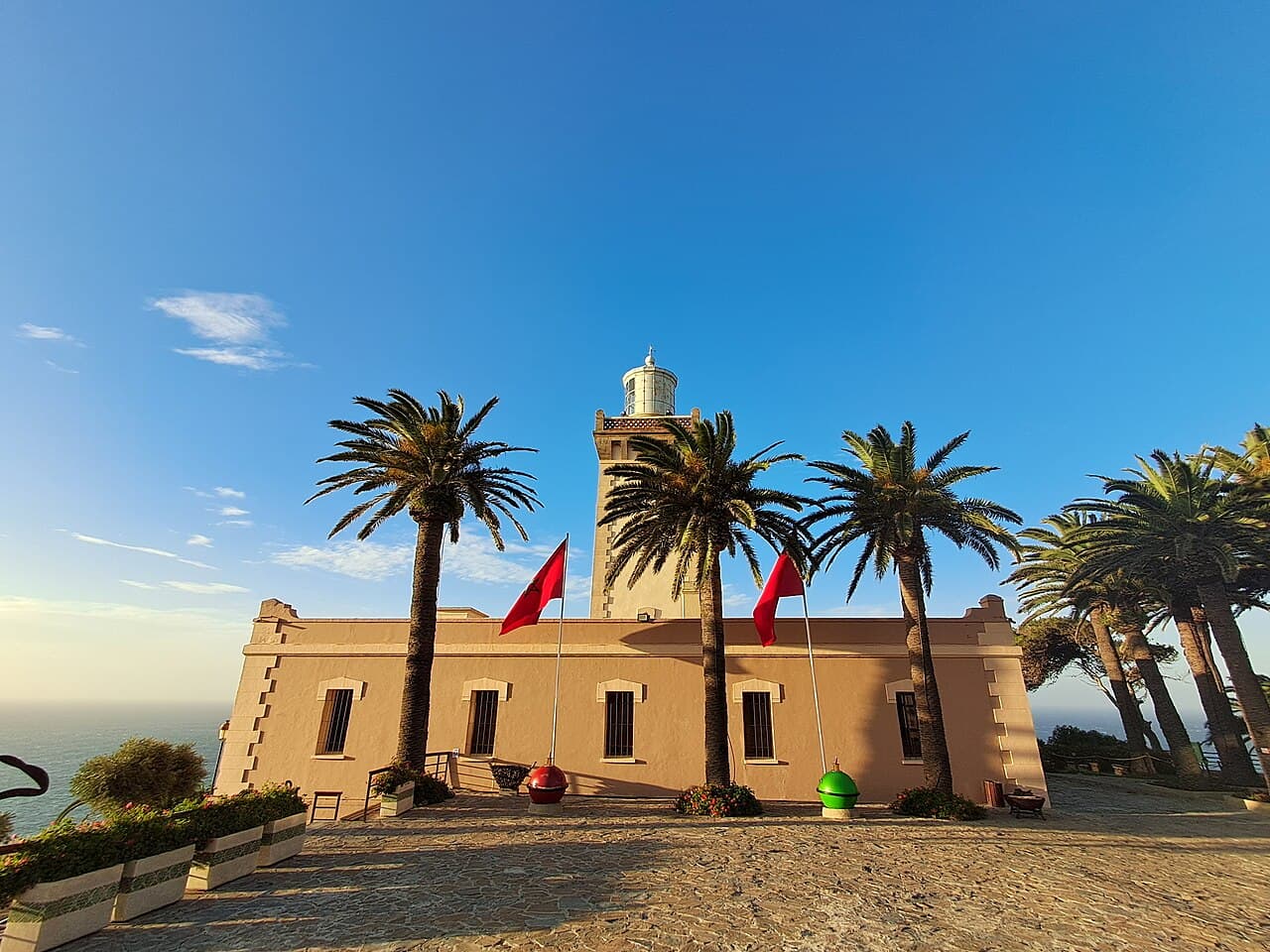
Coastal fog creates dramatic conditions for landscape photography. The lighthouse at Cap Spartel (where the Atlantic meets the Mediterranean near Tangier) is famous for its fog-wrapped appearance. The ramparts of Essaouira emerging from morning mist are another classic shot.
Driving in Fog: Safety Rules
- Reduce speed — fog creates an illusion of slow motion. Cut your speed in half.
- Use low-beam headlights, never high beams. High beams reflect off fog droplets and reduce visibility further.
- Increase following distance to at least 4 seconds.
- Use fog lines (the white line on the right edge of the road) to stay in your lane.
- Do not stop on the roadway. If visibility drops to near zero, pull off the road completely and turn on hazard lights.
- Check conditions on the weather dashboard before early morning departures during summer.
If you're driving from Casablanca to Rabat in summer, consider delaying departure until after 9 AM when coastal fog typically burns off. The drive takes 45 minutes on a clear day but can take over 90 minutes in dense fog.
Key Takeaways
- Casablanca is Morocco's foggiest city (~70 fog days/year), driven by cold coastal upwelling
- Advection fog dominates the coast and peaks in summer (June–August)
- Radiation fog affects inland valleys and peaks in winter (November–February)
- The Rabat–Casablanca corridor is the most fog-affected travel route
- Check weather conditions before early morning travel during fog season
Sources
- DGM (Direction de la Météorologie Générale du Maroc) — Fog frequency climatologies from ground stations
- NOAA — Canary Current sea surface temperature data
- World Meteorological Organization — Guide to fog forecasting
- Moroccan National Highway Authority — Fog-related incident statistics