Morocco's Rainy Season: When, Where, and How Much It Rains
Morocco is not a country that most people associate with rain. The images that dominate travel brochures -- endless sunshine, golden deserts, blue-sky riads -- tell only half the story. In reality, Morocco has a well-defined rainy season that is essential to the country's agriculture, water supply, and ecological health. From November to March, Atlantic weather systems sweep across the country, bringing precipitation that ranges from torrential downpours in the Rif to barely perceptible drizzle at the edge of the Sahara. Understanding when, where, and how much it rains is critical for travelers, farmers, and anyone trying to understand this complex country.
When Is the Rainy Season?
Morocco's rainy season follows the classic Mediterranean pattern: wet winters, dry summers. The transition is governed by the Azores High, a semi-permanent area of high pressure in the central Atlantic Ocean.
The Seasonal Cycle
- June to September: The Azores High shifts northward, extending a ridge of high pressure across Morocco. This blocks Atlantic weather fronts from reaching the country, resulting in almost completely dry conditions across the north and west. Only the extreme southeast occasionally receives convective thunderstorms.
- October: The Azores High begins to retreat southward. The first Atlantic depressions start to track across the western Mediterranean, bringing the season's first rain to northern and western Morocco. October rainfall is erratic; some years it arrives early, some years hardly at all.
- November to March: This is the core of the rainy season. Atlantic depressions, born over the open ocean and steered eastward by the jet stream, cross Morocco at intervals of roughly five to ten days. Each depression brings one to three days of rain, followed by a period of clearer weather.
- April to May: A transitional period. Rain becomes less frequent but can still be heavy when it occurs. By late May, the Azores High has reasserted its dominance and the dry season begins.
Monthly Rainfall Distribution (National Average)
| Month | Average Rainfall (mm) | Character |
|---|---|---|
| January | 45-60 | Peak rainy season |
| February | 40-55 | Continued rain |
| March | 35-50 | Tapering off |
| April | 25-40 | Transitional |
| May | 10-20 | Diminishing |
| June-August | 0-5 | Essentially dry |
| September | 5-15 | First hints of rain |
| October | 20-35 | Season begins |
| November | 40-60 | Rainy season underway |
| December | 50-65 | Peak rainy season |
These national averages mask enormous regional variation, which is the defining feature of Moroccan rainfall.
Where Does It Rain? Regional Variations
Morocco's rainfall map is one of the most varied in the world for a country of its size. From over 2,000 mm in the wettest corners of the Rif to less than 50 mm in the Saharan south, the range is extraordinary.
The Rif Mountains: Morocco's Rain Magnet
The western Rif mountains are by far the wettest part of Morocco. The combination of proximity to the Mediterranean and Atlantic moisture sources, high elevation, and steep west-facing slopes creates ideal conditions for orographic rainfall.
- Annual totals: 1,200 to 2,000 mm in the wettest areas, concentrated around Bab Taza, Ketama, and the high ridges above Chefchaouen.
- Character: Prolonged, steady rain during winter frontal passages, sometimes lasting several days. Snow above 1,500 meters.
- Comparison: The wettest Rif stations receive more rainfall than London, Paris, or even parts of Ireland, a fact that surprises almost everyone.
- Ecological impact: This abundant rainfall supports dense forests of cork oak, Atlas cedar, and maritime pine, giving the Rif a lush, green appearance unlike anywhere else in Morocco.
The Atlantic North: Tangier to Rabat
The coastal strip from Tangier south to Rabat receives 500 to 800 mm of annual rainfall, making it one of Morocco's more productive agricultural regions.
- Tangier: 800 to 900 mm, with a pronounced wet season from November to March.
- Rabat: 500 to 600 mm, slightly drier than Tangier due to its position south of the main storm track.
- Kenitra and the Gharb Plain: 500 to 700 mm, supporting the rich agricultural basin that produces much of Morocco's rice, sugar beet, and citrus.
The Atlantic South: Casablanca to Agadir
Moving south along the coast, rainfall decreases steadily.
- Casablanca: 400 to 450 mm per year.
- El Jadida: 350 to 400 mm.
- Safi: 300 to 350 mm.
- Essaouira: 280 to 320 mm. Despite its oceanic climate, Essaouira receives relatively modest rainfall because the cold upwelling inhibits convection over the water.
- Agadir: 220 to 260 mm, marking the transition to a semi-arid regime.
The Interior: Marrakech and Fes
Inland cities receive less rainfall than their coastal counterparts at the same latitude, because Atlantic moisture is progressively depleted as air masses move inland.
- Marrakech: 230 to 280 mm, concentrated in November to February. Rain can be intense but brief, with long dry spells between events.
- Fes: 450 to 530 mm, wetter than Marrakech due to its proximity to the moisture-rich northern weather track and the orographic enhancement from surrounding hills.
- Meknes: 500 to 580 mm, slightly wetter than Fes due to higher elevation and exposure to Atlantic air.
The Atlas Mountains: Precipitation at Altitude
The Atlas mountains significantly enhance precipitation through orographic lifting. Western and northern slopes receive the most moisture.
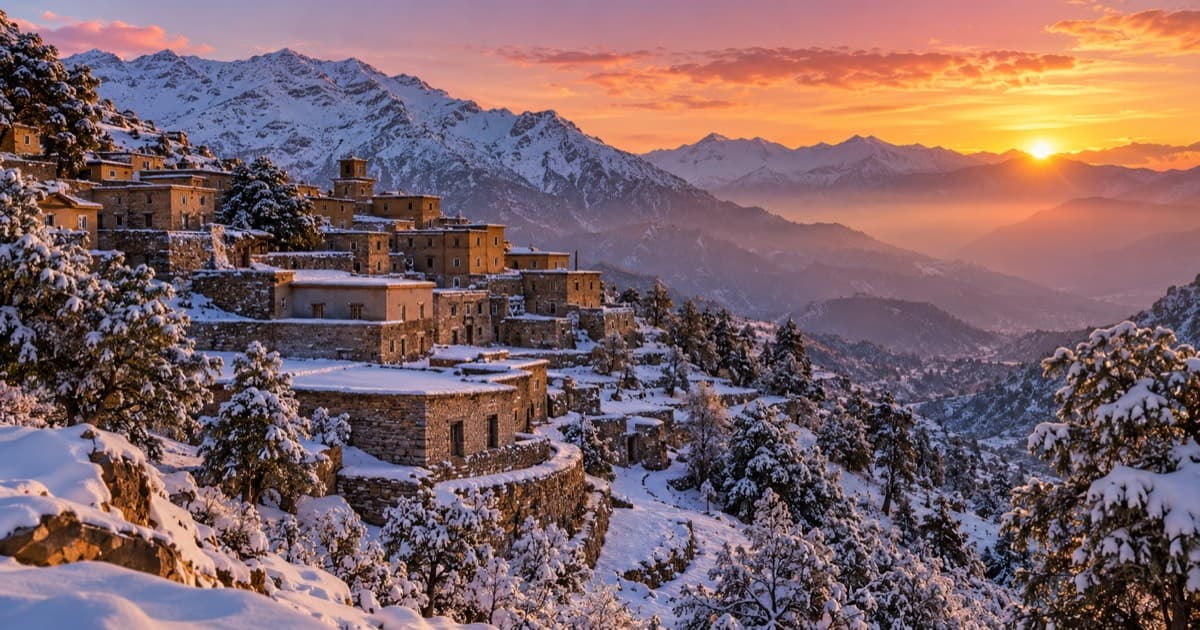
- High Atlas (western slopes): 600 to 1,000 mm, much of it falling as snow above 2,000 meters.
- Middle Atlas: 800 to 1,200 mm, the second-wettest region after the Rif.
- Anti-Atlas: 150 to 300 mm, significantly drier due to its position in the rain shadow of the High Atlas.
The Southeast and Sahara: The Dry Extreme
Southeast of the Atlas, rainfall drops dramatically.
- Ouarzazate: 100 to 120 mm per year.
- Errachidia: 80 to 130 mm.
- Merzouga: 50 to 80 mm.
- Zagora and the Draa Valley: 50 to 70 mm.
- Deep Sahara (Tindouf, Smara): Less than 50 mm, with some years recording zero measurable precipitation.
Rain in the southeast, when it comes, is typically from convective thunderstorms rather than frontal systems. These storms are brief, intense, and highly localized, making rainfall measurement and forecasting extremely challenging.
The Character of Moroccan Rain
Moroccan rain is not like the steady drizzle of northern Europe. It tends to come in distinct, sometimes violent bursts.
Frontal Rain
The majority of winter rainfall comes from Atlantic fronts. A typical frontal passage brings 12 to 36 hours of moderate to heavy rain, preceded by increasing cloud cover and followed by clearing skies and cooler air. These systems move through every five to ten days during the core rainy season, interspersed with dry, sunny intervals.
Convective Storms
In spring and autumn, and occasionally during the rainy season, convective thunderstorms develop when warm surface air rises rapidly and condenses at altitude. These storms can be extremely intense, producing 30 to 50 mm of rain in an hour. They are the primary cause of flash floods, particularly in the south and in mountain valleys.
Intensity
Moroccan rainfall tends to be more intense than rainfall in temperate Europe. While London receives 600 mm of rain spread over 150+ rainy days, Marrakech receives its 250 mm in just 40 to 50 days, meaning each rainy day delivers proportionally much more water. This intensity creates runoff and erosion issues, particularly on deforested or overgrazed slopes.
Flash Floods: The Dark Side of Rain
Morocco's rainy season brings a serious natural hazard: flash floods. The combination of intense rainfall, sparse vegetation, impermeable rocky soils, and steep terrain creates conditions where water accumulates with terrifying speed.
The Wadi System
Much of Morocco is drained by wadis, seasonal riverbeds that are dry for most of the year. During heavy rain, these wadis can transform from dusty tracks into raging torrents in a matter of minutes. Travelers unfamiliar with the terrain sometimes camp in dry wadis, not realizing that rain falling on mountains 50 km away can send a wall of water downstream with no local warning.
Notable Flash Flood Events
- Ourika Valley: This popular day-trip destination from Marrakech has been struck by devastating floods multiple times. A 1995 event killed approximately 200 people when sudden rain in the High Atlas sent floodwaters down the narrow valley.
- Guelmim: In November 2014, severe flooding in this southern Moroccan city killed over 30 people and destroyed hundreds of homes.
- Southern oases: The Draa, Ziz, and Dades valleys are all vulnerable to flash floods that can destroy irrigation infrastructure, wash away crops, and isolate communities.
Safety Advice
- Never camp in or near a dry wadi.
- During heavy rain, avoid river crossings, even paved ones. Water flowing over a road as shallow as 30 cm can sweep a car off the surface.
- Monitor weather forecasts, especially DGM bulletins for orange and red alerts.
- In mountain areas, be aware that rain at your location may be mild, but heavy rain at higher elevations can create downstream flooding.
Drought: When the Rain Does Not Come
While flood is the acute risk, drought is the chronic threat. Morocco's position at the southern edge of the winter storm track means that small shifts in atmospheric circulation can have outsized effects on rainfall.
Recent Drought History
- 2020-2023: Morocco experienced one of its most severe multi-year droughts on record. Dam levels dropped to historic lows, agricultural production fell sharply, and water rationing was implemented in several cities.
- Agricultural impact: Cereal production, which depends heavily on rain-fed farming in the Chaouia, Doukkala, and Saiss regions, dropped by 50 to 70% during the worst drought years.
- Groundwater stress: Over-extraction of groundwater to compensate for surface water shortfalls has depleted aquifers across the country, creating a long-term water security challenge.
The Feast-or-Famine Pattern
Morocco's rainfall tends to follow multi-year cycles of abundance and scarcity. Years of good rainfall can lull planners into complacency, while drought years expose the fragility of water management systems designed for a wetter era. Climate projections suggest that this variability will increase, with both wet extremes and dry extremes becoming more pronounced.
Practical Tips for Rainy Season Travel
Traveling in Morocco during the rainy season is entirely feasible and has significant advantages, including fewer tourists, lower prices, and green landscapes. However, some preparation is needed.
- Waterproof layers: A lightweight rain jacket is essential. Umbrellas are less practical in windy conditions, especially in Tangier and Essaouira.
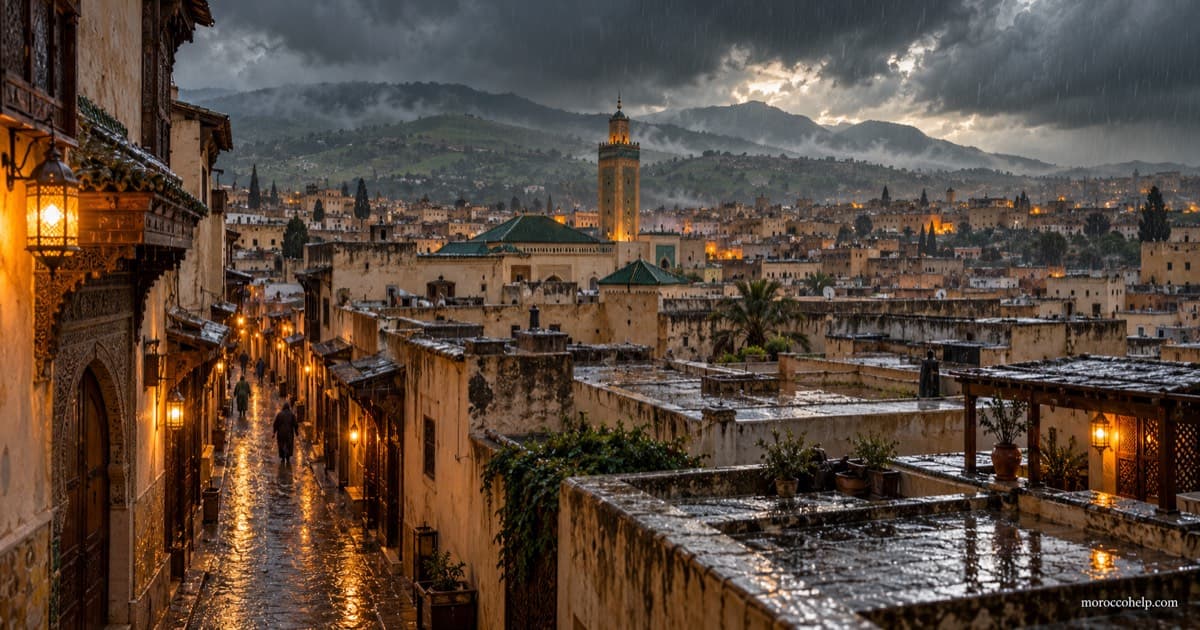
- Waterproof footwear: Medina streets can flood quickly during heavy rain, and unpaved roads become muddy.
- Flexible itinerary: Mountain passes, particularly the Tizi n'Tichka and Tizi n'Test, can close temporarily due to snow or flooding. Have a backup plan.
- Desert trips: Even the Sahara can receive rain during this period. The positive side is that desert landscapes after rain are spectacularly beautiful, with ephemeral wildflowers and filled oasis pools.
- Check dam releases: In the aftermath of heavy rain, controlled dam releases can cause river levels to rise downstream. This is particularly relevant for rafting and kayaking trips on the Oum er-Rbia and other rivers.
Conclusion
Morocco's rainy season is far from a monolithic event. It is a complex, regionally varied phenomenon that sustains a nation's agriculture, fills its reservoirs, feeds its rivers, and occasionally unleashes devastating floods. From the sodden forests of the Rif to the parched expanses of the Sahara, rain in Morocco is a story of extremes: too much in some places, too little in others, and never quite predictable enough for comfort. Understanding this pattern is essential for anyone engaging with Morocco, whether as a visitor, a resident, or a student of its remarkable geography. And for the season that sets the rhythm of these rains, see our guide on when winter starts in Morocco.